
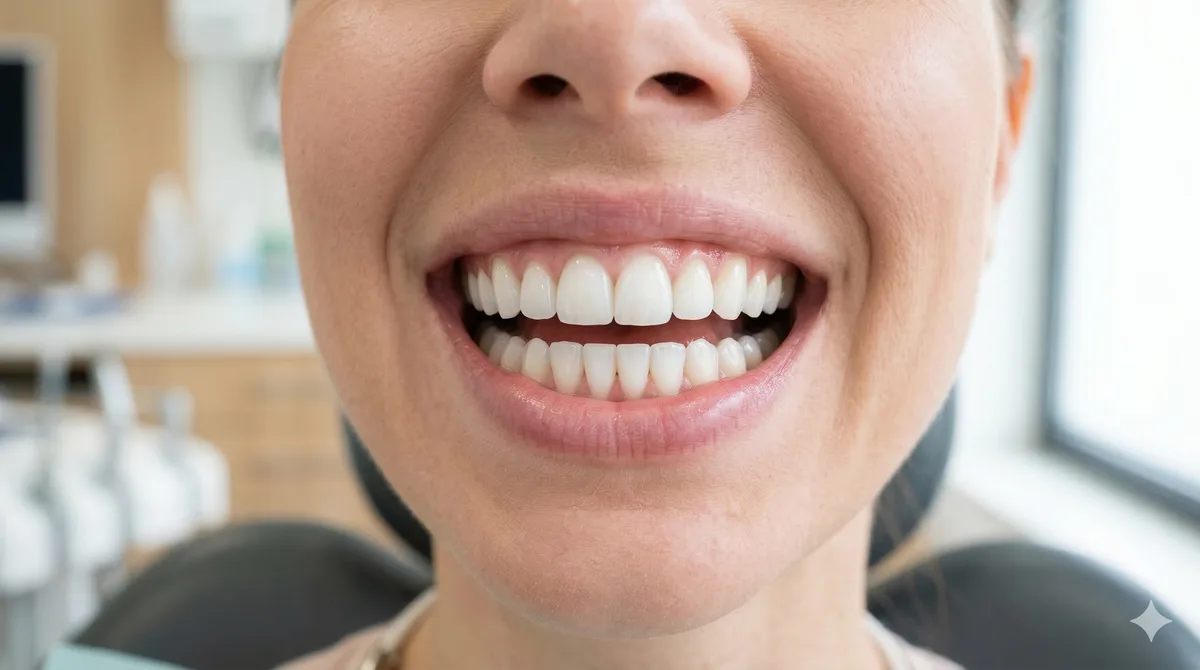
The All-on-4 concept has revolutionized the treatment of total edentulism. Instead of unstable removable dentures or 8–10 individual implants, this technique enables the reconstruction of a complete arch on just 4 implants — often with provisional teeth fixed on the very same day of the procedure.
This guide covers everything you need to know: how it works, who qualifies, what the procedure involves, how much it costs in Romania, and what results to expect.

What Is All-on-4?
All-on-4 is a prosthetic rehabilitation concept developed by Prof. Paulo Malo and initially marketed by Nobel Biocare. The principle is simple yet ingenious: a complete arch of 10–14 teeth is fixed on just 4 implants strategically placed in the jawbone.
The 4 implants are positioned as follows:
- 2 anterior implants — inserted vertically in the front area, where the bone is usually denser
- 2 posterior implants — inserted at a 30–45 degree angle, avoiding the maxillary sinus (upper jaw) or the inferior alveolar nerve (lower jaw), maximizing contact with available bone
The angulation of the posterior implants is the key to the concept: it allows the use of existing bone without the need for additional bone augmentation procedures or sinus lifts, reducing cost, time, and treatment complexity.
All-on-4 vs All-on-6: What Is the Difference?
| Feature | All-on-4 | All-on-6 |
|---|---|---|
| Number of implants | 4 | 6 |
| Biomechanical stability | Very good | Superior |
| Requires abundant bone | Not necessarily | Preferably |
| Average price in Romania (EUR) | 3,500 – 6,500 | 4,500 – 8,000 |
| Main indication | Mandible and maxilla | Maxilla (weaker bone) |
| Resistance to masticatory forces | Good | Excellent |
When is All-on-6 chosen over All-on-4?
- Upper jaw, where bone is less dense
- Patients with bruxism (teeth grinding)
- Cases where a more uniform distribution of forces is desired
- When anatomy allows the placement of 6 implants without additional procedures
In practice, the clinician decides based on the CBCT scan and clinical evaluation. Both options deliver excellent long-term results.
Who Is a Candidate for All-on-4?
All-on-4 is recommended for patients dealing with:
- Total edentulism — complete absence of teeth on one or both arches
- Compromised teeth — teeth with advanced mobility that can no longer be saved
- Severe periodontal disease — advanced periodontitis with generalized bone loss
- Removable denture wearers dissatisfied with stability and comfort
- Patients with insufficient bone for individual implants but enough for the All-on-4 protocol
Conditions That May Limit Eligibility
- Uncontrolled diabetes mellitus (HbA1c > 8%)
- Heavy smoking (over 15 cigarettes/day) — not an absolute contraindication but increases failure risk
- Active treatment with intravenous bisphosphonates (risk of osteonecrosis)
- Recent radiation therapy in the head and neck area
- Uncontrolled autoimmune diseases
A specialist will evaluate each case individually. Many conditions considered “borderline” can be managed with adequate preparation.
Step-by-Step Procedure
Stage 1: Consultation and Diagnosis (Visit 1)
- Complete clinical examination
- Panoramic X-ray and CBCT (3D tomography)
- Assessment of available bone volume
- Discussion about expectations, options, and treatment plan
- Impressions or intraoral scan for prosthetic planning
Stage 2: Digital Planning
- The clinician plans implant positions using specialized software
- A 3D surgical guide is designed (optional but recommended)
- Provisionals are fabricated in the lab (if same-day teeth are chosen)
- Duration: 1–2 weeks
Stage 3: Day of Surgery
- Local anesthesia (or conscious sedation, depending on preference)
- Extraction of remaining teeth, if applicable
- Insertion of 4 or 6 implants
- Fixation of provisionals (provisional fixed prosthesis with 10–12 teeth)
- Duration: 2–4 hours per arch
- Patient leaves with fixed teeth on the same day
Stage 4: Osseointegration Period
- 3–6 months during which implants integrate with the bone
- Soft diet for the first 2–3 months
- Regular check-ups (at 2 weeks, 1 month, 3 months)
- Provisionals remain functional and aesthetic throughout this period
Stage 5: Definitive Prosthesis
- Definitive impressions (digital or conventional)
- Fabrication of the final prosthesis in the lab
- Materials: titanium-reinforced acrylic, full zirconia, or ceramic on titanium framework
- Try-in and occlusal adjustment
- Final fixation
Immediate Loading vs Delayed Loading
Same-day teeth (immediate loading) is possible when:
- Primary stability of implants is at least 35 Ncm
- Bone has adequate density
- No extensive bone augmentation was required
Delayed loading is recommended when:
- Primary stability is insufficient
- Significant bone augmentation was performed
- Bone quality is compromised
In most All-on-4 cases, immediate loading is possible, meaning the patient leaves the clinic with fixed teeth on the same day — one of the greatest advantages of this concept.
All-on-4 and All-on-6 Prices in Romania
| Component | Approximate price (EUR) |
|---|---|
| All-on-4 per arch (with provisionals) | 3,500 – 6,500 |
| All-on-6 per arch (with provisionals) | 4,500 – 8,000 |
| Definitive prosthesis — acrylic on titanium | 1,500 – 2,500 |
| Definitive prosthesis — zirconia | 2,500 – 4,500 |
| Both arches All-on-4 | 7,000 – 13,000 |
| Conscious sedation (optional) | 200 – 400 |
Prices vary depending on the implant brand, the definitive prosthesis material, and case complexity. Romania offers prices 50–70% lower than Western European clinics, using the same brands and protocols.
You can request a personalized quote through our form — partner clinics typically respond within 24–48 hours.
Longevity and Success Rate
Long-term clinical data is highly encouraging:
- Implant success rate: 95–98% at 10 years (studies published in Clinical Implant Dentistry and Related Research)
- Implant lifespan: 20+ years with proper hygiene, potentially lifetime
- Prosthesis lifespan: 10–15 years for acrylic on titanium, 15–20+ years for zirconia
- Patient satisfaction: over 95% report significant improvement in quality of life
Factors That Influence Longevity
- Oral hygiene — daily brushing, special implant floss, oral irrigator
- Regular check-ups — at least one dental visit every 6 months
- Quitting smoking — smoking remains the most important modifiable risk factor
- Avoiding overloading — extremely hard foods, opening bottles with teeth
Maintenance and Hygiene
All-on-4 prostheses require specific hygiene care:
- Electric toothbrush with special implant heads
- Super Floss or interdental brushes for cleaning under the prosthesis
- Oral irrigator (water flosser) — very useful for hard-to-reach areas
- Professional scaling every 6 months — with special implant instruments (no metal ultrasonic tips)
Risks and Possible Complications
Like any surgical procedure, All-on-4 carries certain risks:
- Implant failure (2–5%) — usually during the osseointegration phase, resolvable by reinsertion
- Postoperative infection — rare with adequate prophylactic antibiotic therapy
- Inferior alveolar nerve injury — lip numbness, very rare with CBCT-guided planning
- Sinusitis — possible in the upper jaw, treatable
- Provisional fracture — can occur during the osseointegration period, repairable
Most complications are minor and manageable. Choosing an experienced All-on-4 clinician and rigorous planning significantly reduce the risks.
Frequently Asked Questions (FAQ)
Is It Painful?
The procedure is performed under local anesthesia, so you will not feel pain during the surgery. Postoperative discomfort is moderate — comparable to a complex tooth extraction — and is managed with standard anti-inflammatory medication. Most patients return to normal activities within 2–3 days.
How Long Does the Entire Procedure Take?
From the first consultation to the definitive prosthesis: 4–6 months. The surgical procedure itself takes 2–4 hours per arch, and the patient leaves with provisional fixed teeth on the same day.
Can I Eat Normally?
With provisionals: soft diet for 2–3 months (pasta, rice, ground meat, soup). With the definitive prosthesis: you can eat almost anything, including fruits, meat, and crunchy foods. It is recommended to avoid extremely hard foods (very hard nuts, ice).
All-on-4 or Removable Dentures?
All-on-4 offers stability, comfort, and aesthetics far superior to removable dentures. It does not move, requires no adhesive, does not cover the palate, and allows efficient chewing. The only disadvantages compared to dentures: higher cost and the need for a surgical procedure.
What Happens if an Implant Fails?
If an implant does not osseointegrate, it can be reinserted after a healing period of 2–3 months. The provisional prosthesis can be temporarily adapted to 3 implants. Complete treatment failure is extremely rare.
Is There an Age Limit?
There is no upper age limit. All-on-4 has been successfully performed on patients over 80 years old. The basic requirement is a general health condition that permits a minor surgical procedure under local anesthesia.
Conclusion
All-on-4 represents the most efficient solution for patients who have lost all their teeth or have irreparably compromised teeth. With success rates exceeding 95%, the possibility of having fixed teeth on the very day of surgery, and affordable prices in Romania, this concept has fundamentally changed how total edentulism is treated.
If you are considering All-on-4 or All-on-6 treatment, the first step is a consultation with a specialist who will evaluate your clinical situation through examination and 3D tomography. You can find specialized clinics in your area or request a personalized quote directly through our platform.