
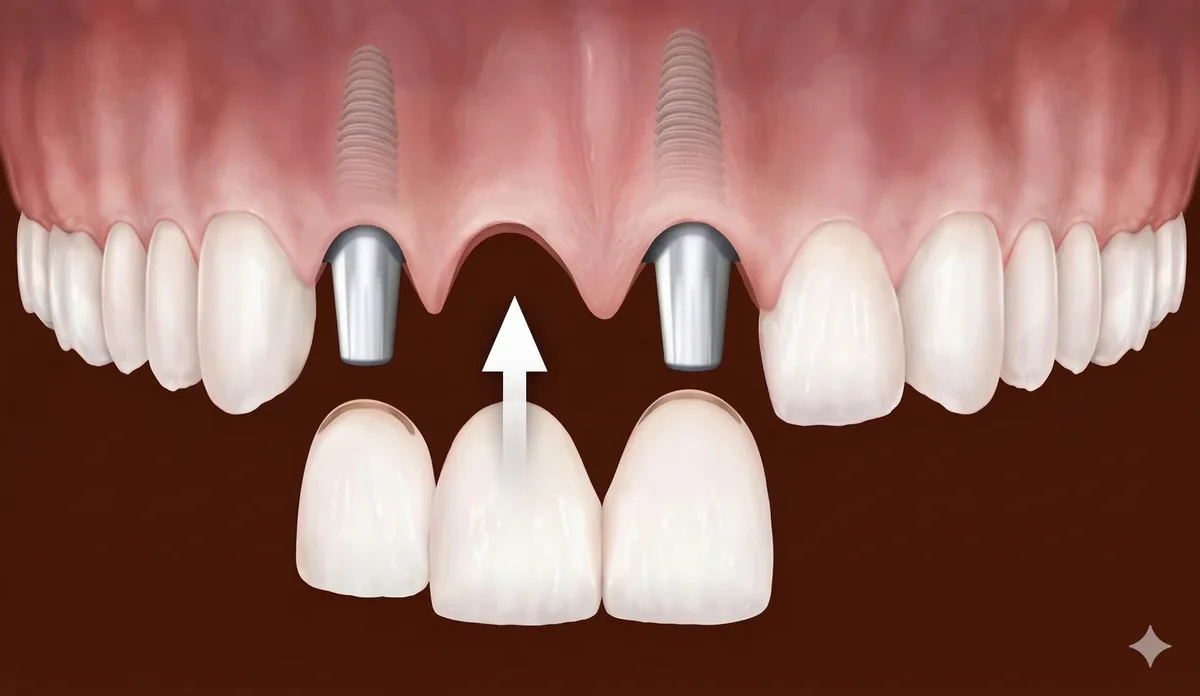
When you lose one or more teeth, the two main replacement options are the dental implant and the dental bridge. Each solution has clear advantages and disadvantages, and the right choice depends on your clinical situation, available budget, and long-term expectations.
This article will help you understand the fundamental differences, compare the real long-term costs, and identify which option is best suited to your case.
What Is a Dental Implant?
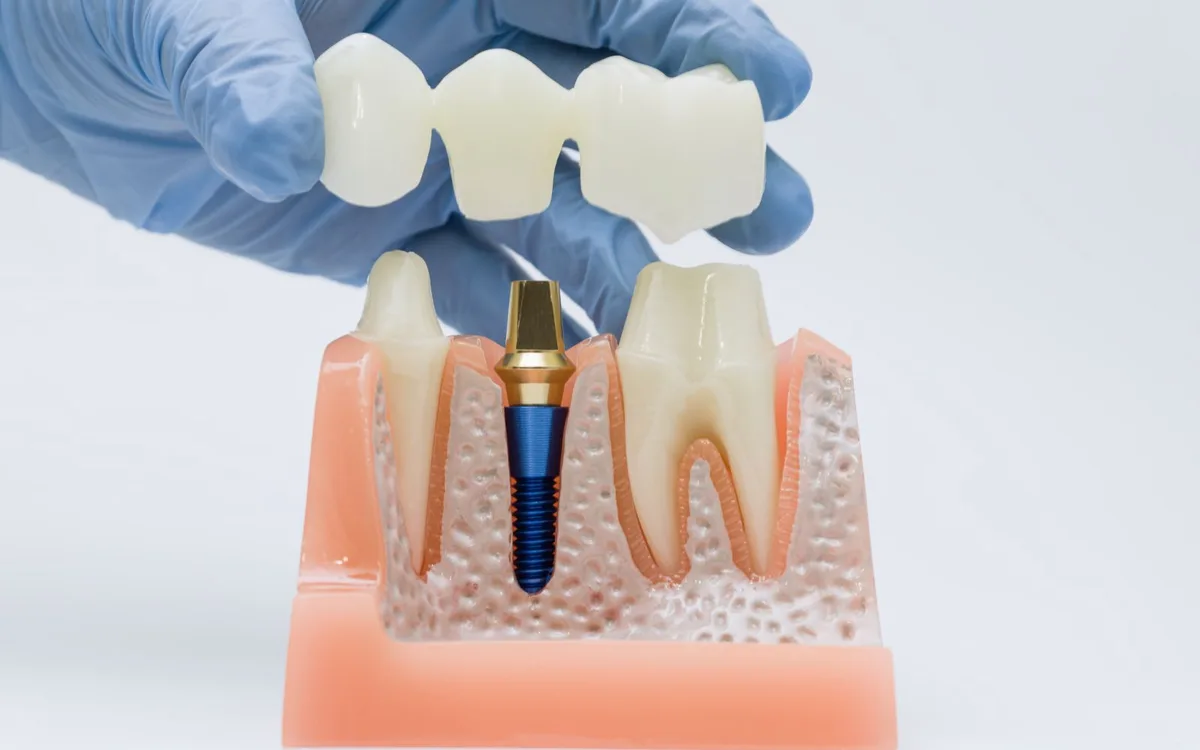
A dental implant is a titanium (or zirconia) screw surgically inserted into the jawbone, replacing the root of the lost tooth. After an osseointegration period of 3–6 months, a prosthetic abutment and a crown are attached to the implant — the result being an independent artificial tooth that looks, functions, and feels like a natural tooth.
Components: implant (artificial root) + prosthetic abutment (connecting piece) + crown (visible tooth).
What Is a Dental Bridge?
A dental bridge is a fixed prosthetic restoration that “replaces” one or more missing teeth by anchoring onto the adjacent natural teeth. The teeth on either side (called “abutment teeth”) are prepared (trimmed down) and covered with crowns, and between them sits a pontic — the artificial tooth that fills the gap.
Example: For one missing tooth, a classic bridge involves 3 crowns — two on the neighboring teeth (abutments) and one suspended (the pontic).
Direct Comparison: Implant vs Bridge
| Criterion | Dental implant | Dental bridge |
|---|---|---|
| Durability | 20–30+ years | 7–15 years |
| Initial price (EUR) | 400 – 900 | 300 – 600 (3 crowns) |
| Bone preservation | Yes, prevents resorption | No, bone resorbs under the bridge |
| Affects neighboring teeth | No | Yes, requires preparation |
| Total treatment time | 3–6 months | 2–3 weeks |
| Aesthetics | Excellent | Very good |
| Hygiene | Similar to a natural tooth | More difficult under the pontic |
| Surgical procedure | Yes | No |
| Success rate | 95–98% at 10 years | 85–90% at 10 years |
When to Choose a Dental Implant
The implant is generally considered the gold standard for replacing missing teeth. It is especially recommended when:
1. The Neighboring Teeth Are Healthy
This is the strongest argument in favor of the implant. A bridge requires the preparation of two healthy teeth — removing a significant layer of enamel and dentin — to make room for the abutment crowns. This procedure is irreversible and turns intact teeth into restored teeth, with all associated risks (sensitivity, future need for root canal treatment).
The implant, on the other hand, is completely independent — it does not touch or affect the adjacent teeth.
2. You Want to Prevent Bone Resorption
When a tooth is lost, the bone in that area begins to gradually resorb because it no longer receives stimulation through chewing. This process is irreversible and progressive.
- The implant transmits masticatory forces directly into the bone, maintaining bone volume — just like a natural tooth.
- The bridge does not stimulate the bone in the gap area. Under the pontic, bone resorption continues, leading over time to an aesthetic dead end — a visible depression in the gingiva beneath the bridge.
3. You Are Planning Long-Term
With an average lifespan of over 20 years (and often for life), the implant is the most durable solution. Once osseointegrated, the implant itself does not “wear out” — only the crown on top may need replacement after 15–20 years.
4. A Single Tooth Is Missing
When a single tooth is missing, the implant is almost always the optimal option. A bridge for a single missing tooth requires sacrificing two healthy teeth — a compromise that is hard to justify.
When to Choose a Dental Bridge
The bridge remains a valid solution in certain situations:
1. The Neighboring Teeth Are Already Restored
If the teeth adjacent to the gap already have crowns or large fillings, the bridge becomes a more logical option — the teeth already need crown coverage, and the bridge provides this simultaneously with replacing the missing tooth.
2. Bone Is Insufficient and You Do Not Want Augmentation
Patients with significant bone loss may require bone augmentation or a sinus lift before implant placement. These procedures add cost, time, and complexity. The bridge does not require sufficient bone because it is supported by teeth, not bone.
3. Medical Conditions That Contraindicate Surgery
Patients with uncontrolled diabetes, on intravenous bisphosphonate therapy, with severe coagulation disorders, or other conditions that make surgical procedures risky may benefit from a bridge as a non-surgical alternative.
4. Limited Short-Term Budget
The initial cost of a bridge is lower than that of an implant. If budget is an immediate constraint, the bridge offers a quicker and more affordable functional solution.
5. Limited Time Available
A bridge is completed in 2–3 weeks. An implant requires 3–6 months of osseointegration. If time is a critical factor (an important event, for example), the bridge delivers a quick result.
Long-Term Cost Analysis
Although the bridge has a lower initial price, the long-term analysis shifts the perspective:
| 20-year scenario | Dental implant | Dental bridge |
|---|---|---|
| Initial cost | EUR 600 | EUR 400 |
| Replacement at 10 years | EUR 0 | EUR 400 (new bridge) |
| Replacement at 15 years | EUR 0 | possibly EUR 400 |
| Root canal on abutment teeth | EUR 0 | EUR 200–400 (15–20% risk) |
| Estimated total cost over 20 years | EUR 600 | EUR 800 – 1,200 |
Financial conclusion: The implant costs more initially, but is more economical in the long term. The bridge requires periodic replacement, and the abutment teeth may develop complications that add additional costs.
Impact on Neighboring Teeth
This is an insufficiently discussed but extremely important aspect.
What Happens to the Bridge Abutment Teeth?
- Preparation removes 1–2 mm of healthy dental tissue on the entire surface of the tooth — an irreversible process
- Risk of root canal treatment increases by 15–20% in the first 10 years, as preparation can affect the dental pulp
- Risk of decay under the crown — if the crown margin is not perfect, bacteria can infiltrate underneath
- If an abutment tooth is lost, the entire bridge must be remade, possibly with a longer bridge or a different type of restoration
What Happens to the Teeth Adjacent to the Implant?
- Nothing. The implant is completely independent and does not affect the neighboring teeth in any way.
Bone Resorption — The Ignored Factor
Bone loss under a dental bridge is a real and progressive phenomenon. In the first 2 years after extraction, approximately 40–60% of the ridge bone volume is lost. This process continues slowly over the years.
Practical consequences:
- Aesthetic: A concavity forms under the pontic, visible especially in the front area
- Functional: Food can become trapped between the bridge and gingiva
- Prosthetic: When replacing the bridge, the larger gap can make the prosthetic restoration more difficult
The implant prevents this phenomenon through continuous bone stimulation, similar to a natural root.
Real-Life Scenarios
Scenario 1: 35-year-old, lost molar, healthy neighboring teeth
Recommendation: Implant. At this age, an implant can last a lifetime. Sacrificing two healthy teeth for a bridge is not justified, especially since the bridge will need replacement at least 2–3 times over a lifetime.
Scenario 2: 70-year-old, missing tooth, neighboring teeth with old crowns
Recommendation: Bridge. The neighboring teeth already have crowns that need replacement anyway. The bridge solves both problems simultaneously, without a surgical procedure.
Scenario 3: 3 consecutive missing teeth, atrophied bone
Recommendation: It depends. If the patient accepts bone augmentation, 2 implants with a bridge on implants is the ideal solution. If not, a classic bridge on remaining natural teeth can be a reasonable alternative.
Scenario 4: Missing front tooth, aesthetics is a priority
Recommendation: Implant. The front area is the most visible, and bone resorption under a bridge will eventually create an aesthetic defect. The implant maintains the bone and natural gingival contour.
Useful Questions for Your Dentist
If you are hesitating between the two options, discuss the following with your dentist:
- What is the condition of the neighboring teeth — are they intact or do they have existing restorations?
- Is there enough bone for an implant, or would augmentation be necessary?
- Are there medical conditions that contraindicate the implant?
- What lifespan do you estimate for each option, in my particular case?
- What happens if an abutment tooth of the bridge develops problems in the future?
Conclusion
The dental implant is considered the gold standard for replacing missing teeth — it offers superior durability, preserves bone, does not affect neighboring teeth, and has the best long-term cost-benefit ratio. The dental bridge remains a valid alternative in specific situations: neighboring teeth already restored, contraindications for surgery, or limited budget.
The right decision depends on your individual clinical situation. A specialist can guide you to the optimal choice after a complete evaluation. Consult our clinic directory to find a specialist in your area or request a personalized evaluation.